
Özyeğin University, Çekmeköy Campus Nişantepe District, Orman Street, 34794 Çekmeköy - İSTANBUL
Phone : +90 (216) 564 90 00
Fax : +90 (216) 564 99 99
E-mail: info@ozyegin.edu.tr

Article Selection
Article Selection
Article Selection
MULTI-ECOLOGICAL PERSPECTIVES ON PALIMPSEST CITIES IN THE ANTHROPOCENE
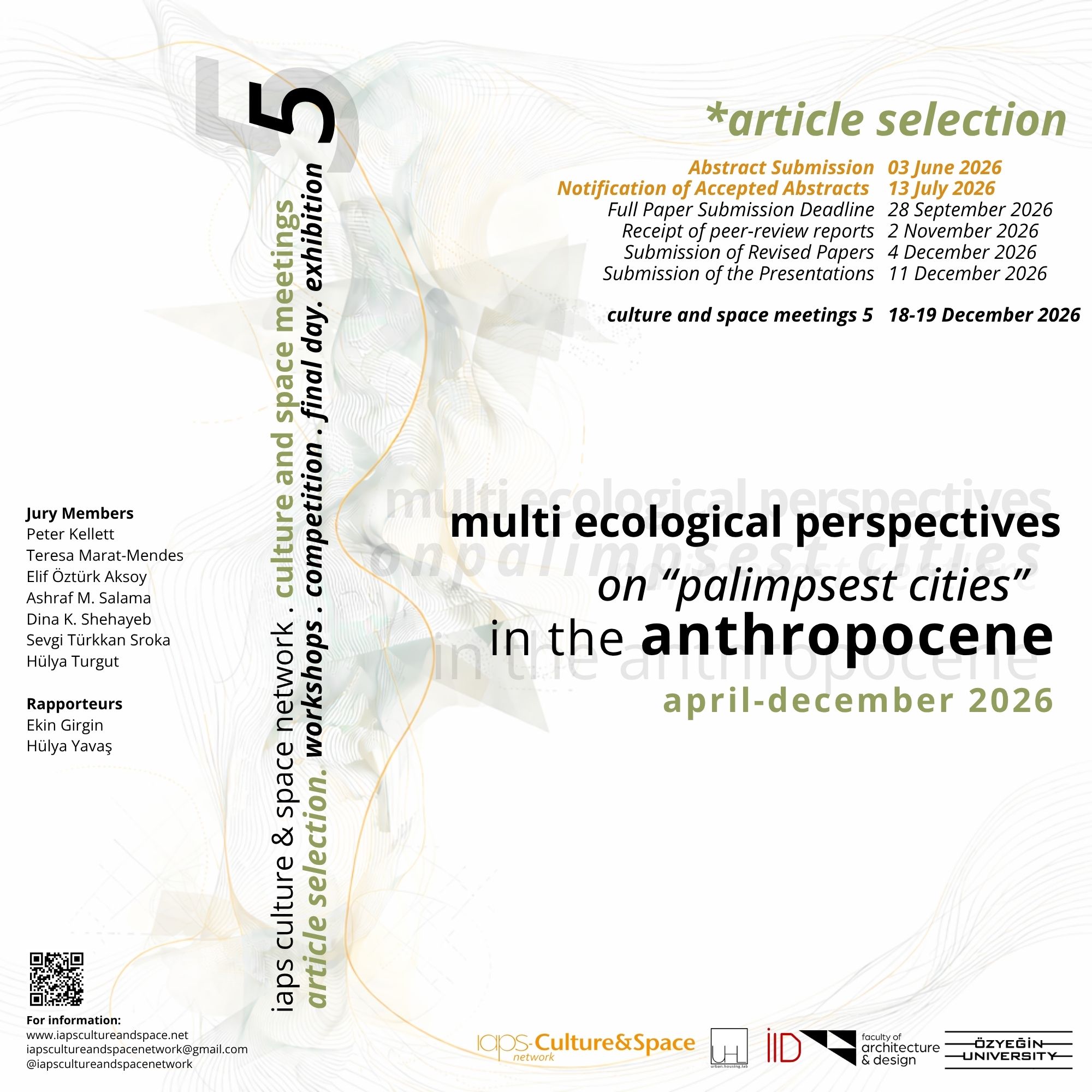
JURY MEMBERS*
Peter Kellett; Newcastle University, School of Architecture, United Kingdom; IAPS–CS Network
Teresa Marat-Mendes; ISCTE, School of Technology and Architecture, Portugal
Elif Öztürk Aksoy; Architectural Researcher, PhD, (Award-winning article author, IAPS–CS Network Activities 4, 2018–2019)
Ashraf M. Salama; Northumbria University, School of Architecture, Newcastle, United Kingdom; IAPS Education Network
Dina K. Shehayeb; Nile University, Giza, Egypt
Sevgi Türkkan Sroka; Istanbul Technical University Faculty of Architecture, Istanbul, Türkiye
Hülya Turgut; Ozyegin University, Faculty of Architecture and Design, Türkiye;
IAPS–C&S Network, Urban & Housing Lab ‘OZU-UHL’
* In alphabetical order

Rapporteurs
Ekin Girgin, Halic University, Faculty of Architecture; Ph.D. student, ITU (ekingirgin17@gmail.com)
Hülya Yavaş, Ozyegin University, Faculty of Architecture and Design; Ph.D. student, ITU (hulya.yavas@ozyegin.edu.tr)
Within the scope of the article selection, contributions are expected to critically, conceptually, and theoretically engage with the overarching thematic framework of “Multiple Ecological Perspectives on Palimpsest Cities in the Anthropocene” focusing on the multi-layered, fragile, and dynamic nature of urban environments. In this regard, theoretical readings, critical comparisons, conceptual modelings, as well as experimental applications drawing from critical urban theory, ecological thought, memory studies, speculative design, futures studies, and relational spatial approaches constitute key components of the selection. The aim is to establish a comprehensive intellectual framework that approaches urban space not merely as a physical settlement, but as a complex formation where historical, ecological, and social processes are deeply intertwined.
In the Anthropocene, cities are being reshaped by planetary-scale ecological transformations, climate-related uncertainties, and socio-environmental disruptions. This condition challenges established assumptions of urban stability, continuity, and linear progress. Within this context, cities are increasingly understood as palimpsestic formations in which accumulated historical layers intersect with contemporary ecological crises and future imaginaries that remain open, contingent, and subject to negotiation. Accordingly, the city emerges as a layered construct that carries traces of the past, confronts the multiplicity of present crises, and simultaneously accommodates divergent potential futures.
The primary aim of this call is to reconsider palimpsest cities through a future-oriented lens and to develop new theoretical and methodological approaches at the intersection of space, time, memory, transformation and futurity. In this respect, the Anthropocene is understood not only as an era of environmental crisis, but also as a temporal and epistemic threshold that transforms the production of urban knowledge and spatial imaginaries.
Contributions are expected to critically examine how Anthropocene dynamics—such as climate change, environmental degradation, resource depletion, and multispecies entanglements—reconfigure urban temporalities and spatialities. Furthermore, submissions are encouraged to develop critical problematizations of possible urban futures and to propose alternative scenarios that expand the horizon of urban thinking.
Authors are expected to construct conceptual continuities between the past, present, and possible futures of palimpsest cities; to build an interdisciplinary and critical field of inquiry; and to propose innovative urban imaginaries and theoretical frameworks. Submitted works should be grounded in a robust theoretical foundation, include systematic critical analysis, and develop original conceptual and/or methodological contributions that deepen the understanding of urban transformation under Anthropocene conditions.
All submissions will be evaluated through a double-blind peer review process conducted by the Selection Committee. The selected article will be encouraged to be published in an internationally indexed journal; additionally, together with the other outputs of the event they are planned to be published in a national book, and together with other selected papers from the series in an international book.
Participation Requirements
The selection is organized as an article competition open to doctoral candidates who have completed their PhD theses within the last five years or who are currently pursuing their doctoral research, and whose work is related to the overall theme of the event series.
Papers must be original and single-authored.
Originality: Papers must be original, single-authored, and previously unpublished. A similarity check will be conducted. The paper must not be under review in another journal.
Use of artificial intelligence: Artificial intelligence tools must be used responsibly and transparently. AI should not replace human contribution but should support it. Content generated or modified by AI must be clearly disclosed. The name and version of the AI tool used must be specified. The use of generative AI for text production (writing, content generation) is not permitted. However, AI may be used for language correction, editorial assistance, and text improvement.
Award-winning participants are expected to present their papers on the final day of the 5th IAPS-CS Culture and Space Meetings, to be held on 18–19 December 2026. Participants from abroad may deliver their presentations online. Selected papers will be prepared for publication by the authors.
Important Notes
Participants are required to submit a one-page short CV and their abstracts in English by 3 June 2026, by completing the online form at https://forms.gle/bzTL598Mi6JhfXpn6. A 1000-word abstract, including the title of the paper and summarizing its aims, methodology/approach, and findings with references, must be submitted. Five keywords should be carefully selected to represent the research. Author names must not be included on this page.
The language of the papers is English, and they must be single-authored.
Papers must be submitted in accordance with the specified formatting guidelines, including original figures and tables, in both Word (.doc) and PDF formats, to the editorial office of the Paper Selection Committee at iapscultureandspacenetwork@gmail.com.
Submitted papers will not be returned to the authors. Authors’ names, addresses, institutional affiliations, titles, telephone numbers, and email addresses must be included in the cover letter. All submissions will undergo a double-blind peer-review process, with author identities concealed.
Formatting Guidelines
Papers must not exceed 8,000 words. This limit includes the abstract, references, all text in tables, figures, and appendices.
Paper title _Page 1: The first page should include a concise, clear, and sufficiently informative title.
Author information_Page 2: The second page must include the author’s full name (to be published in full), email address (preferably institutional), and institutional affiliation (the institution to which the author was affiliated during the research period).
Notes_Endnotes: Footnotes or endnotes should be used only when strictly necessary. They should be indicated in the text using sequential numbers in square brackets. These numbers must then be listed and explained at the end of the paper.
References: In-text citations and the reference list must be formatted according to the Harvard referencing style.