
Özyeğin University, Çekmeköy Campus Nişantepe District, Orman Street, 34794 Çekmeköy - İSTANBUL
Phone : +90 (216) 564 90 00
Fax : +90 (216) 564 99 99
E-mail: info@ozyegin.edu.tr

SDG 12 Responsible Consumption and Production
SDG 12 Responsible Consumption and Production
SDG 12 Responsible Consumption and Production
ISO 14001 Environmental Management System Standard Certificate
Özyeğin University is the first university in Turkey to receive the ISO 14001 Environmental Management System Standard Certificate. Established in 2012, the system was certified in 2014. At Özyeğin University, the requirements of the standard are periodically monitored, reporting is carried out, and internal audits are conducted. It is also audited every year. Following the audit conducted in 2026, our certificate was renewed for a 3-year period on April 6, 2026. Özyeğin University has adopted environmental sustainability as one of its primary core criteria since its foundation and campus construction. In accordance with its environmental, energy, and water management policy, the University conducts environmental impact analyses and focuses on improvement activities to minimize natural resource consumption based on the outputs obtained. In addition to energy management, waste management, and carbon footprint reporting, corporate water footprint reporting is also carried out regularly.
The ISO 14001 Environmental Management System is a management system developed to systematically reduce and, where possible, eliminate the damage that organizations cause or may cause to the environment. In this context, the corporate policy is stated through the published Environmental, Energy, and Water Management Policy(September 7, 2026), and practices, duties, and concepts are expressed in the Environmental Management Plan(September 7, 2026). The Campus Energy and Water Resources Usage Guide(September 7, 2026) has been published, and environmental considerations are explained in detail.
LEED Gold Certificates
In our buildings, which were built with the LEED approach determined according to the criteria set forth by the USGBC (United States Green Building Council), the design and construction of our campus buildings were carried out considering water saving and waste management. Wells were opened on the campus, plumbing systems were installed for rain harvesting and Grey Water use in the buildings, appropriate plants were selected and a landscape plan was implemented with drip irrigation systems. Materials were selected to minimize the impact on the environment and the resulting waste was directed to recycling. It was reported to the USGBC that sufficient infrastructure and other requirements were concretely realized for our three buildings and they were certified at the Gold level. Afterwards, the design and construction of the other additional buildings on the campus were carried out with the same approach according to the USGBC criteria.
Integrated Environmental Information System/Zero Waste Information System
Integrated Environmental Information System and Zero Waste Information System are software that monitors environmental processes by the ministry. Monthly waste amounts are entered into these systems. The amounts of recycling waste received by the licensed company that the municipality has an agreement with are also entered monthly through the Zero Waste Information System.
Özyeğin University became the first university to receive the Zero Waste Certificate as of 14.02.2020. Additionally, thanks to the effective implementation of resource efficiency, on-site waste separation, and recovery efforts at the Çekmeköy campus and student dormitories, the university was granted the “Zero Waste Certificate” again on June 11, 2025, following inspections carried out by the Ministry.
Industrial Waste Management Plan
Our Industrial Waste Management Plan was first approved by the Provincial Directorate of Environment, Urbanization and Climate Change on 30.04.2014 and is prepared regularly every 3 years and submitted to the Provincial Directorate of Environment, Urbanization and Climate Change.
Waste Management Policy
Purpose
At Özyeğin University, we are committed to adopting an integrated approach to environmental, energy, and water management in order to protect the environment, enhance energy and water efficiency, and ensure the sustainable use of natural resources across our campus. This policy is firmly grounded in the integrated management systems approach in alignment with the University’s sustainability vision. This approach supports the reduction of environmental impact, promotes the efficient use of resources, and fosters the continuous improvement of environmental performance. This policy embraces the “reduce, replace or reuse” approach for the efficient use of water. The policy also aims to contribute to the University’s broader vision: “Creating value, being recognized, preferred, and emulated as an entrepreneurial research university with scientific, social, and economic global impact."
Our Goals
Özyeğin University is dedicated to enhancing its energy and water efficiency, minimizing its environmental impact, and ensuring the sustainable use of resources in all its operations. The systematic monitoring, measurement, analysis, and evaluation of energy and water consumption across the campus are essential components of this approach. Based on these data, water efficiency indicators and basic water efficiency indicators are established, performance goals are identified, and continuous improvement initiatives are scheduled. The University’s primary goals include reducing greenhouse gas emissions, ensuring energy security, and protecting water resources. To achieve these goals, the University encourages the transformation of consumption habits and the adoption of practices aligned with the principles of the circular economy. Additional environmental goals include the segregation of waste at its source, waste reduction, reuse, and increasing recycling rates. Promoting a culture of sustainable living across the entire campus community is also a key component of these goals.
Fundamental Principles
Özyeğin University adopts an integrated approach to environmental, energy, and water management in line with the principles of sustainability. The responsible and efficient use of natural resources forms the foundation of all our administrative practices. Energy and water efficiency are treated as top priorities in our efforts to minimize environmental impact and optimize resource consumption across the campus. To that end, the systematic monitoring, analysis, and continuous improvement of consumption data are among our core principles. Waste management constitutes a fundamental component of our environmental policy. In alignment with the Zero Waste approach, we prioritize the segregation of waste at the source, reduction of waste generation, reuse of materials, and the increase of recycling rates to promote not only environmental sustainability but also operational efficiency. As Özyeğin University, we are committed to taking all necessary measures to protect the environment, prevent pollution, and ensure the sustainability of biodiversity and ecosystems. At the same time, we develop policies that contribute to the fight against climate change and actively promote the adoption of innovative, low-impact, and sustainable technologies. Our University is dedicated to evaluating opportunities to enhance water efficiency performance when designing new buildings, equipment, systems, or processes. In addition, for the procurement of services, products, and equipment that have a significant impact on water usage, suppliers are assessed based on their water efficiency performance, and appropriate procurement specifications are defined to ensure efficient water use. All these practices are carried out in strict adherence to effective national and international environmental legislation and compliance requirements. Regular review and continuous improvement of environmental performance are central to our approach.
Procedure
Özyeğin University is committed to implementing and continuously improving the ISO 14001, ISO 50001, and ISO 46001 systems as part of its integrated approach to environmental, energy, and water governance. The applicability and effectiveness of these systems are regularly reviewed and supported through systematic improvements. Energy and water consumption is continuously monitored, measured, and analyzed. Based on these evaluations, performance goals are determined, and these goals are achieved through technical improvements, operational controls, and strategies that foster behavioral change. Hazardous and non-hazardous wastes are managed in accordance with effective legislation. Waste management practices are standardized across the campus and continuously monitored to ensure compliance and efficiency. In line with circular economy principles, the reuse and recycling of resources are actively supported. Risks and opportunities related to environmental, energy, and water efficiency management are periodically reviewed. To achieve the University’s sustainability goals, necessary resources are allocated, comprehensive training is provided to all stakeholders, and active participation is encouraged. This policy applies to all areas of the campus, including academic buildings, dormitories, laboratories, social and green spaces, and infrastructure systems.
Waste Management Plan
| Atık Tipi | Atık Kaynağı | Atığın En Aza İndirilme Yöntemi | Atığın Kaynağında Toplanma Yöntemi | Atığın Bertaraf Edilene Kadar Saklanma Yöntemi | Miktar Takibinden Sorumlu Departman | Miktarı | Periyot | Bertaraf Yöntemi |
| Organik Atık / Evsel Atık / Çöp | Cafe/Yemekhane vd | Bilinçli Tüketim Sağlanması | İlgili Kuruluşça | Çöp Toplama Alanları | İdari İşler | Takip edilmekte | Gün | Belediye |
| Metal | Kampüs Yaşam Alanları | Bilinçli Tüketim Sağlanması | Kullanıcıların Kumbaralara atması | Kumbaralarda / Geri Dönüşüm Atıkları Toplama Yerleri | İdari İşler | Takip edilmekte | Haftalık | Belediye |
| Cam | Kampüs Yaşam Alanları | Bilinçli Tüketim Sağlanması | Kullanıcıların Kumbaralara atması | Kumbaralarda / Geri Dönüşüm Atıkları Toplama Yerleri | İdari İşler | Takip edilmekte | Haftalık | Belediye |
| Plastik | Kampüs Yaşam Alanları | Bilinçli Tüketim Sağlanması | Kullanıcıların Kumbaralara atması | Kumbaralarda / Geri Dönüşüm Atıkları Toplama Yerleri | İdari İşler | Takip edilmekte | Haftalık | Belediye |
| Kağıt + Ambalaj Atıkları | Kampüs Yaşam Alanları | Bilinçli Tüketim Sağlanması | Kullanıcıların Kumbaralara atması | Kumbaralarda / Geri Dönüşüm Atıkları Toplama Yerleri | İdari İşler | Takip edilmekte | Haftalık | Belediye |
| Diğer Geri Dönüştürülebilir atıklar / Mobilya Atıkları /Hurda atıklar | Kampüs Yaşam Alanları | Bilinçli Tüketim ve Alım yapılması | Kullanıcıların ve Teknik Ekibin Geri Kazanım istasyonuna/ teknik depolarında biritirmesi | Geri Dönüşüm atık toplama yerleri / Teknik Hizmetler depoları | Teknik Hizmetler | Takip edilmekte | İhtiyaca göre | Belediye |
| Tehlikeli Atık – Lab | Lab Kimyasalları | Bilinçli Tüketim ve Alım yapılması | Lablarda güvenli alanlarda PE bidonlarda konması | Lablarda güvenli alanlarda PE bidonlarda saklanması / Tehlikeli atık geçici depolama alanı | Lab/İdari İşler | Takip edilmekte | Yılda 2 kere | EAG |
| Bitkisel Atık Yağ | Cafe/Yemekhane vd | Bilinçli Tüketim Sağlanması | İlgili Kuruluşça | Atık Toplama Odaları | İdari İşler | Takip edilmekte | İhtiyaca göre | Habitat |
| Elektronik Atık | Kampüs Yaşam Alanları | Bilinçli Tüketim Sağlanması | BT birimince toplanıyor | IT help desk birimince | BT | Takip edilmekte | Yılda 2 kere | EAG |
| Pil | Kampüs Yaşam Alanları | Bilinçli Tüketim Sağlanması | TAP Kutuları aracılığı ile | TAP Atık pil kutularında | İdari İşler | Takip edilmekte | Yılda 2 kere | TAP - Taşınabilir Pil Üreticileri ve İthalatçıları Derneği |
| Tıbbi Atık | Revir / Sağlık Merkezi | Bilinçli Tüketim Sağlanması | Revir Yetkilileri aracılığı ile | Sağlık Merkezi özel çöp kutusu | HSE - Sağlık Merkezi | Takip edilmekte | İhtiyaca göre | İSTAÇ |
| Aküler | EDM | Bilinçli Tüketim Sağlanması | Teknik Birim Yetkilileri aracılığı ile | Tehlikeli atık geçici depolama alanı | Teknik Hizmetler | Takip edilmekte | Yılda 2 kere | EAG |
| Atık Yağ | EDM / Laboratuvarlar | Bilinçli Tüketim Sağlanması | Teknik Birim Yetkilileri aracılığı ile | Tehlikeli atık geçici depolama alanı | Teknik Hizmetler | Takip edilmekte | Yılda 2 kere | PETDER |
| Ampül ve balast | Kampüs Yaşam Alanları | Bilinçli Tüketim Sağlanması | Teknik Birim Yetkilileri aracılığı ile | Tehlikeli atık geçici depolama alanı | Teknik Hizmetler | Takip edilmekte | Yılda 2 kere | EAG |
| Bahçe Atıkları (Çim Atık) | Kampüs Yaşam Alanları | Bilinçli Peyzaj Aktivitelerinin Sağlanması | Peyzaj Frması aracılığı ile | Peyzaj alanlarında depolama/kompostlaştırma | Teknik Hizmetler | Takip edilmekte | Yılda 12-20 kez | Büke |
| Bahçe Atıkları (Budama Atıkları) | Kampüs Yaşam Alanları | Bilinçli Peyzaj Aktivitelerinin Sağlanması | Peyzaj Frması aracılığı ile | Peyzaj alanlarında depolama/kompostlaştırma | Teknik Hizmetler | Takip edilmekte | Yılda 2 kez | Büke |
| Klima santralleri torba filtreleri | Kampüs Yaşam Alanları | Bilinçli Tüketim Sağlanması | Teknik Birim Yetkilileri aracılığı ile | Tehlikeli atık geçici depolama alanı | Teknik Hizmetler | Takip edilmekte | Yılda 2 kere | EAG |
| Tekstil-Elbise | Kampüs Yaşam Alanları | Bilinçli Tüketim Sağlanması | Kullanıcıların Kumbaralara atması | Kumbaralarda | İdari İşler | Takip edilmekte | Haftalık | Belediye |
| Kontamine atık | Kampüs Yaşam Alanları | Bilinçli Tüketim Sağlanması | Teknik Birim ve Operasyon Yetkilileri aracılığı ile | Tehlikeli atık geçici depolama alanı | Teknik Hizmetler / İdari İşler | Takip edilmekte | Yılda 2 kere | EAG |
| Kontamine ambalaj | Kampüs Yaşam Alanları | Bilinçli Tüketim Sağlanması | Teknik Birim ve Operasyon Yetkilileri aracılığı ile | Tehlikeli atık geçici depolama alanı | Teknik Hizmetler / İdari İşler | Takip edilmekte | Yılda 2 kere | EAG |
| Atık bor yağ | EDM / Laboratuvarlar | Bilinçli Tüketim Sağlanması | Teknik Birim ve Operasyon Yetkilileri aracılığı ile | Tehlikeli atık geçici depolama alanı | Teknik Hizmetler / İdari İşler | Takip edilmekte | Yılda 2 kere | EAG |
| Tehlikeli parça içeren ıskarta ekipmanlar | Kampüs Yaşam Alanları | Bilinçli Tüketim Sağlanması | Teknik Birim ve Operasyon Yetkilileri aracılığı ile | Tehlikeli atık geçici depolama alanı | Teknik Hizmetler / İdari İşler | Takip edilmekte | Yılda 2 kere | EAG |
| Kartuş-Toner | Fotokopi Makineleri | Bilinçli Tüketim Sağlanması | İlgili Kuruluşça | İhtiyaca göre değiştirilerek | BT | Takip edilmekte | İhtiyaca göre | Kyocera |
| Antrifiz sıvıları | EDM / Laboratuvarlar | Bilinçli Tüketim Sağlanması | Teknik Birim Yetkilileri aracılığı ile | Tehlikeli atık geçici depolama alanı | Teknik Hizmetler | Takip edilmekte | Yılda 2 kere | EAG |
Hazardous Wastes
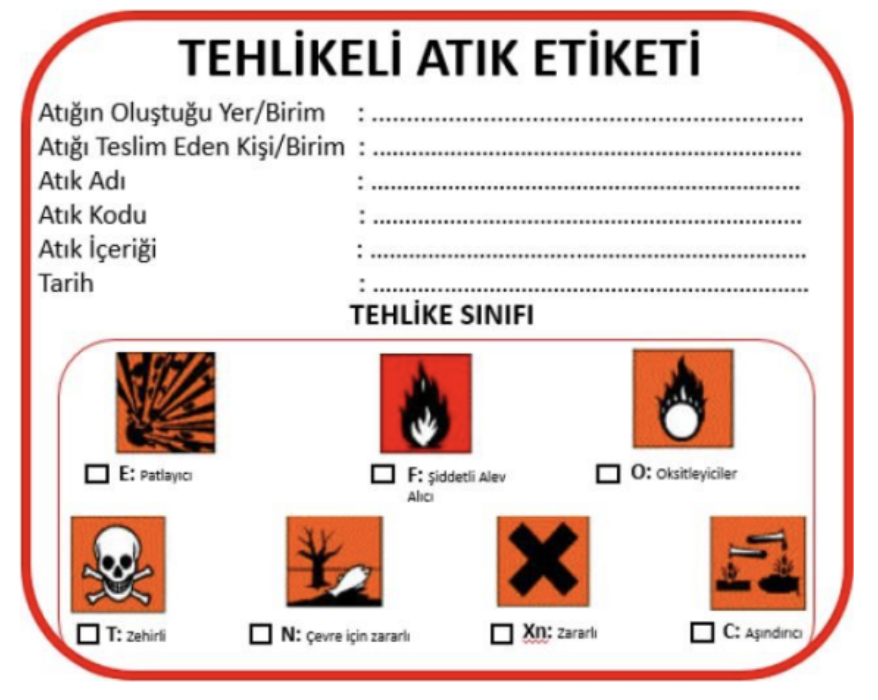
Contracts have been made with licensed companies for our hazardous wastes and their recycling and disposal are ensured by regularly reporting them through the Integrated Environmental Information System, and waste declarations are made through this system every year. Hazardous wastes are packaged appropriately, labeled with a hazardous waste label and sent to the Hazardous Waste Temporary Storage Area.
Medical Waste Acceptance Certificate
The necessary applications for the Medical Waste Acceptance Certificate are made regularly every year and our certificate is issued by the IMM Waste Management Directorate.
Sending waste papers for destruction within the scope of information security
An agreement has been made with TEMA Foundation for the destruction of waste papers within the scope of information security and the income obtained is donated to TEMA Foundation.
Organic Waste / Composting
Garden and park waste is collected, composted by a contracted company and evaluated on campus. In the gastronomy department, vegetable and fruit peels from the cafeteria are evaluated as food again. Organic waste from the cafeteria is also evaluated for animal feed and compost production. In this context, our cafeteria company has joined the Responsible Restaurant Movement.
The Responsible Restaurant Movement is a project that was launched to ensure that all businesses providing food and beverage services carry out the entire service flow from energy use to waste management, from water use to supply, preparation and service processes with a responsible approach, and operate with a focus on sustainability by creating a conscious behavioral change in production and consumption.

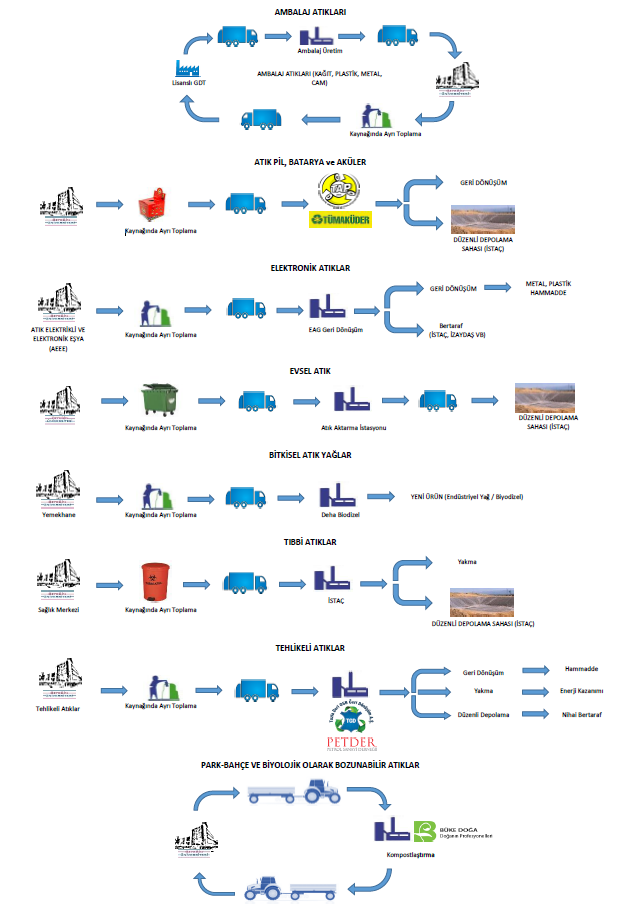
Environment Life Cycle
Life cycle analysis is the compilation and evaluation of the inputs, outputs and potential environmental impacts of a product system throughout its life cycle.
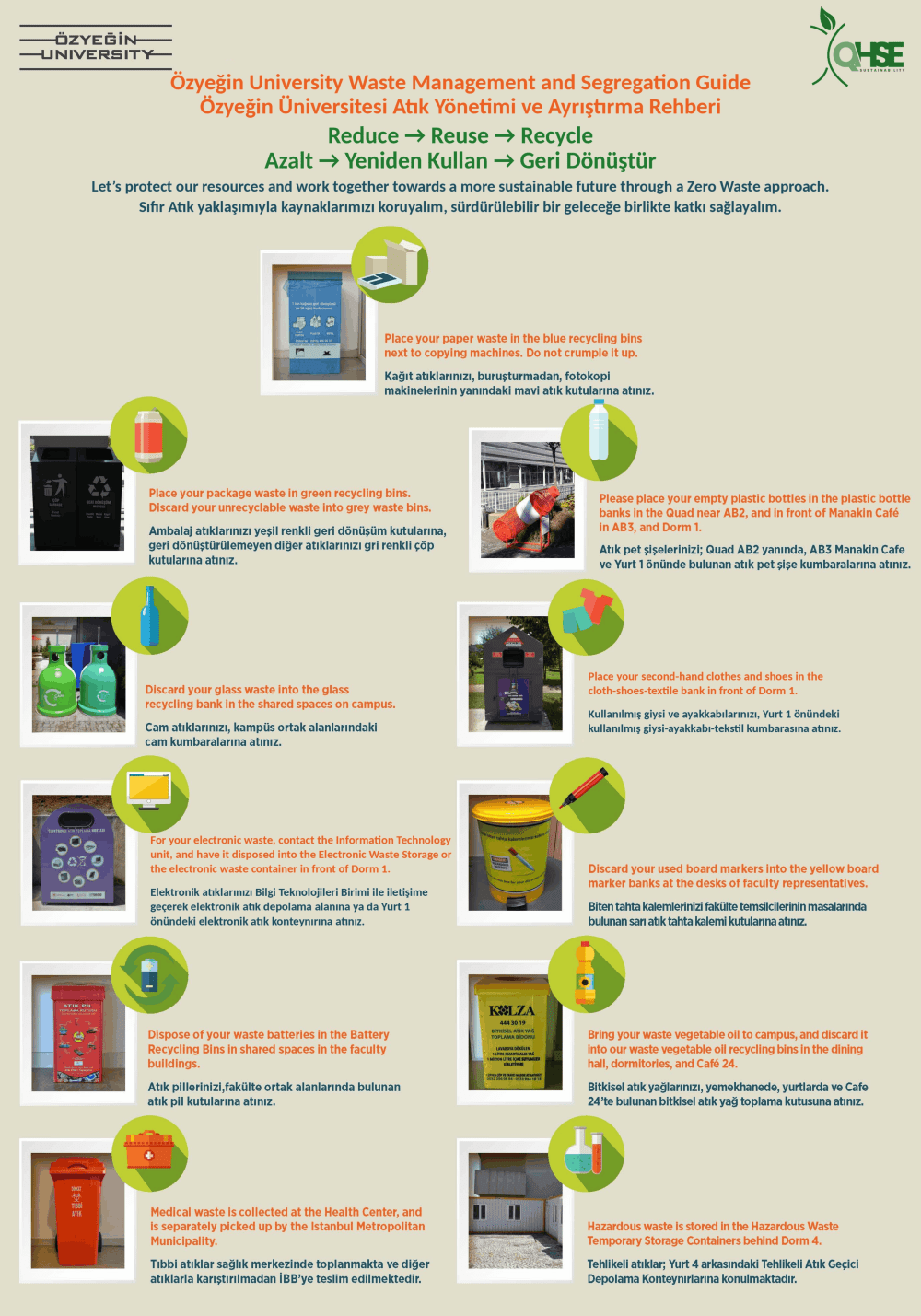
Waste Collection Bins and Locations
Practices for Reducing Single-Use Items at Özyeğin University
Özyeğin University implements effective measures to reduce the use of single-use items in line with its overall sustainability vision and commitments under the ISO 14001 Environmental Management System.
1. Commitments at Policy Level
Within the scope of the university’s “Environment, Energy, and Water Efficiency Policy,” reducing waste at the source, increasing reuse, and improving recycling rates are key objectives. This approach indirectly but strongly supports the reduction of single-use items.
2. Waste Management Practices
- Recycling bins are widely placed across the campus.
- Students and staff are informed and encouraged to use reusable items instead of single-use products.
- Waste is properly collected through a source-separation system, which helps to minimize waste and prevent unnecessary disposal.
3. Campus Applications
- Environmentally friendly and reusable materials are promoted in events.
- Water dispensers with filtration systems have replaced traditional bottled water systems (water coolers) across the campus.
- Students and staff are encouraged to use reusable water bottles; glass bottles are provided to staff members.
- Plastic and paper cups are no longer supplied in campus kitchens.
- Single waste bins in classrooms and offices have been removed, and the use of dual waste bins (recycling and general waste) in common areas is encouraged.
- Single waste bins in outdoor areas are planned to be replaced with dual waste bins as well.
4. Awareness and Education
- Guidance documents, posters, and announcements on waste reduction, recycling, water, and energy efficiency are provided to students and staff, and training sessions are conducted.
- Student organizations such as the HSE Community organize various awareness-raising activities on these topics.
Our University Declares the 2026–2027 Academic Year the “Year of Paper and Waste”
Our university, which embraces sustainability as one of its core values, has declared the 2026–2027 academic year the “Year of Paper and Waste,” following the initiatives undertaken during the “Year of Water” in 2025–2026. This decision aims to ensure the continuity of our environmental sustainability efforts while raising institutional and public awareness of responsible resource use.
Protecting natural resources, preventing waste generation, and using resources efficiently are becoming increasingly important for a sustainable future. In line with the Zero Waste approach and circular economy principles, institutions have an important role to play in transforming consumption habits, reducing waste generation, and improving recovery practices.
As a university holding a Zero Waste Certificate, we will focus on further improving our existing waste management practices, with particular emphasis on reducing paper consumption, preventing waste generation, promoting reuse, and enhancing resource recovery.
Key Initiatives for the Year of Paper and Waste:
- Reducing paper consumption: Expanding digital processes, preventing unnecessary printing, and developing practices to minimize paper use.
- Preventing waste generation: Reducing single-use products, encouraging reusable alternatives, and promoting sustainable consumption habits.
- Improving waste management: Enhancing waste segregation at source, improving resource recovery processes, and strengthening Zero Waste practices.
- Measurement and monitoring: Monitoring paper consumption and waste quantities, setting reduction targets, and evaluating improvement results.
- Education and awareness: Organizing training sessions, information campaigns, and awareness-raising activities for academic and administrative staff, students, and campus businesses.
- Student engagement and projects: Developing student-led projects focusing on waste reduction, reuse, and recycling.
- Collaborations: Establishing partnerships with public institutions, local authorities, and other stakeholders to promote environmental awareness and improve waste management.
Expected Outcomes:
- Achieving measurable reductions in paper consumption and waste generation across campus.
- Improving resource efficiency and strengthening resource recovery practices.
- Raising awareness of sustainable consumption and waste management among university stakeholders.
- Increasing active participation of students and staff in environmental sustainability initiatives.
- Contributing to our university's sustainability efforts at national and international levels.
A sustainable future begins with the responsible use of resources. Throughout the Year of Paper and Waste, our university aims to reduce waste generation, improve resource efficiency, and make sustainable practices an integral part of campus life.
Amounts of Waste Generated at Ozyegin University (kg)
| Waste Type | 2025 |
| Organic Waste/Trash | 1,364,549 |
| Garden-Park Waste (Compostable Waste) | 17,185 |
| Packaging Waste (Paper, Plastic, Metal, Glass) | 66,854 |
| Other Recyclable Wastes | 15,050 |
| Hazardous Wastes (Laboratory and EDM) | 7,460 |
| Vegetable Waste Oil | 4,755 |
| Textile-Dress | 2,450 |
| Electronic Waste | 1,470 |
| Medical Waste | 255 |
| Battery | 0 |
| Waste Cartridge Toner | 73 |
| Total | 1,480,101 |